This section consolidates Zaphyr Pomicpic's behavioral data across his entire career span within the organization into a singular, averaged career-wide assessment.
Zaphyr Pomicpic
Comprehensive DISC Longitudinal Assessment Report

Section 1: Average Summary
Response to Volatility and Organizational Threat
Dominance:
25% Influence:
8% Steadiness:
25% Conscientiousness:
42%Averaged Composite Profile: The "Guardian of Quality" (High C / Secondary D & S) – Average Similarity Score: 0.91.
Role Recommendations: Crisis Manager, Legal Compliance Coordinator, Lead Systems Architect. These roles leverage his ability to enforce order, build fail-safes, and generate structured, verifiable documentation amidst organizational chaos.
Mentorship and Structural Capability Building
Dominance:
12% Influence:
20% Steadiness:
33% Conscientiousness:
35%Averaged Composite Profile: The "Master Craftsman" (S + C) – Average Similarity Score: 0.87.
Role Recommendations: Director of Training, Operations Director, Financial Systems Implementer. These roles align with his ability to formalize operations, eliminate ambiguity, and translate complex enterprise workflows into structured educational curriculums.
Variant A (Catalyst Average) - Detailed Analysis
Narrative Summary: Across Zaphyr’s tenure, situational catalysts consistently involved high-stress environments, ranging from abrupt personnel transitions and executive volatility to ethically questionable mandates and sudden system lockouts. Under the pressure of continuous organizational volatility and direct executive threats, Zaphyr’s behavioral profile undergoes a stark transformation. In early crises, his response to chaos was to act as a "Shock Absorber," utilizing Steadiness to diffuse tension while deferring to procedural execution. However, as the severity of the catalysts escalated, his stabilizing Steadiness (S) and relational Influence (I) traits plummeted. He transitioned into a highly clinical, defensive posture characterized as "Turtling" under ethical stress—withdrawing into indisputable data, objective deliverables, and strict procedural compliance to avoid the messiness of emotional conflict. When passive resistance was no longer viable under absolute structural threat, Zaphyr's "Shadow Self" activated, pivoting to a High Dominance / High Compliance posture to weaponize deep systemic knowledge and aggressively establish boundaries against executive intimidation.
Strengths: Maintains exceptional operational control during chaotic transitions; demonstrates profound psychological resilience; refuses to fold under severe intimidation; de-escalates high-risk situations through meticulous procedural adherence and irrefutable data provision.
Risks: Suppresses strategic insights early in conflicts to avoid triggering highly dominant leaders; relies heavily on passive resistance (literal compliance) rather than confronting unethical mandates directly until pushed to the absolute limit; becomes entirely inflexible and combative once structural trust is broken.
Variant B (Neutral/Positive Average) - Detailed Analysis
Narrative Summary: When operating autonomously in constructive environments focused on expanding team capabilities, internal education, and system implementation, Zaphyr thrives. In a stable, project-based environment, he operates as the ultimate "Master Craftsman" and the "Heart of the Team." His averaged baseline demonstrates a profound equilibrium between Steadiness (33%) and Compliance (35%), paired with a healthy resurgence of Influence (20%). Without the burden of defensive posturing, he actively builds strong interpersonal rapport with trainees and acts as an empathetic steward for the remote workforce. Given the space to build, he engineers complex technical stacks into digestible, multi-day training modules and operational flowcharts, creating a "Proven Path" for incoming staff to eliminate ambiguity. Furthermore, he demonstrates high emotional intelligence by actively advocating for his subordinates to aggressive leadership, protecting team morale.
Strengths: Highly capable and patient mentor; breaks down complex multi-system environments into learnable modules; produces flawless technical documentation ensuring standardization across distributed remote teams; acts as a highly protective buffer for team members.
Risks: May prioritize teaching, quality, and relationship-building over immediate speed or raw production metrics; prone to over-engineering processes, creating rigid frameworks that may struggle to adapt if leadership demands sudden pivots.
Section 2: Variants Explanation (“The Why”)
A typical DISC Personality Assessment provides a single snapshot of an individual’s behavioral tendencies. While useful, this static view often misses the dynamic nature of human behavior—especially in professional environments where stress, culture, and context can dramatically alter how someone operates. Introducing two variants—Catalyst and Neutral—makes the assessment exponentially more powerful and practical, particularly in HR, recruitment, and remote workforce management.
Catalyst
Stress/Trigger ContextThis variant captures how an individual’s traits shift when exposed to high-pressure situations. Situational catalysts—such as sudden executive demands, technical infrastructure failures, or interpersonal conflicts—act as forcing functions. As demonstrated in Zaphyr's profile, a naturally steady and collaborative employee may suppress relational traits and become highly dominant and rigidly compliant when systems fail, enforcing strict rules to regain control and mitigate operational damage.
Neutral
Positive/Stable ContextThis variant reflects the person’s natural, constructive tendencies when psychological safety and supportive conditions are present. It reveals how the individual thrives in collaborative or creative environments. Constructive influences—such as autonomy in project design, team capability building, and mentorship opportunities—stabilize scores, allowing relational (Influence) and supportive (Steadiness) traits to synergize with analytical capabilities.
Relevance in Multicultural and Remote Contexts: In global and remote teams, cultural norms shape how behaviors are expressed and interpreted. By separating Catalyst and Neutral variants, HR professionals can contextualize behavior, reducing bias and misinterpretation. It answers critical recruitment questions: How will this person perform in routine tasks? versus How will they react when things go wrong? This dual lens ensures that recruiters can design balanced, resilient teams, pairing individuals whose stress responses complement each other, ultimately improving retention, conflict management, and strategic succession planning.
Section 3: Detailed Report (Anonymized)
Phase 1: First 12 months
Variant A (Catalyst): Organizational Volatility and Abrupt Personnel Transitions
Catalyst Summary: Zaphyr faced high-stress channel communications involving sudden executive directives to terminate subordinate employees. This forced Zaphyr to suppress highly relational (I) traits in favor of supportive execution (S) and procedural compliance (C).
Narrative: During periods of abrupt personnel transitions, Zaphyr demonstrates a "Shock Absorber" dynamic, utilizing high Steadiness to diffuse tension and execute directives with minimal friction. Rather than asserting dominance or emotional persuasion, Zaphyr reverts to procedural updates and calm affirmations, maintaining a low-volatility profile while the executive drives the conflict.
Profile Match: The "Specialist / Technician" (0.89)
Dominance:
15% Influence:
15% Steadiness:
40% Compliance:
30%Variant B (Neutral/Positive): Team Rapport Building and Operational Resources
Neutral/Positive Influence: When tasked with training new hires and converting operational requirements into tangible resources, Zaphyr's scores shift to reflect high analytical capability mixed with steady mentorship. The absence of immediate threat allows Influence (I) to emerge through supportive coaching.
Narrative: In a neutral environment focused on capability-building, Zaphyr acts as the "Heart of the Team," balancing high Steadiness with increased Influence. He actively builds rapport with trainees while feeding a Compliance need by developing structured workflow diagrams and decision matrices to ensure consistency.
Profile Match: The "Relater / Counselor" (0.85)
Dominance:
10% Influence:
25% Steadiness:
35% Compliance:
30%Phase 2: Mid-career snapshot
Variant A (Catalyst): Executive Demand for Contracts and Ethically Questionable Directives
Catalyst Summary: Zaphyr was issued an urgent, high-risk directive from the executive to forge signatures on employment contracts. This extreme compliance test forced him into a highly conscientious, risk-mitigating posture to satisfy the operational demand without explicitly engaging in the unethical action.
Narrative: Under the severe stress of an ethically questionable mandate, Zaphyr demonstrates "Turtling"—withdrawing into data and objective deliverables to avoid the messiness of the ethical conflict. Rather than directly challenging the dominant leader, he leans heavily into High Compliance (C) to supply meticulously organized spreadsheets and smoothly bypass the forgery instruction.
Profile Match: The "Guardian of Quality" (0.92)
Dominance:
15% Influence:
5% Steadiness:
25% Compliance:
55%Variant B (Neutral/Positive): Mentorship and Implementation of Structured Training
Neutral/Positive Influence: Operating in a constructive environment focused on expanding team capabilities, Zaphyr mentors staff through complex, multi-system environments, demonstrating a balanced mix of Steadiness and Compliance to assure quality without overwhelming the trainees.
Narrative: When given the space to build and mentor, Zaphyr relies on the "Proven Path" (High C/S) while exhibiting patience with new learners. He actively advocates for trainees to the executive, demonstrating high emotional intelligence by protecting subordinates while methodically guiding their progress.
Profile Match: The "Master Craftsman" (0.88)
Dominance:
15% Influence:
20% Steadiness:
35% Compliance:
30%Phase 3: Final 12 months
Variant A (Catalyst): System Lockouts and Technical Audit Failures
Catalyst Summary: The culmination of a highly toxic relationship loop resulted in sudden technical lockouts, withheld compensation, and extreme hostility, pushing Zaphyr to activate a "Shadow Self" to legally and operationally defend his boundaries.
Narrative: Under absolute structural threat and financial manipulation, Zaphyr abandons all deferential behavior, transitioning into a High D / High C posture. He directly confronts the executive with irrefutable facts, aggressive boundary setting, and deep procedural knowledge to construct a formidable, legally robust severance demand.
Profile Match: The "Strategist / Perfectionist" (0.94)
Dominance:
45% Influence:
5% Steadiness:
10% Compliance:
40%Variant B (Neutral/Positive): Essential Software Training and Mentorship
Neutral/Positive Influence: When operating autonomously to generate value via internal education (e.g., developing an intensive software curriculum), Zaphyr thrives. The creative and systematic requirement of building an educational curriculum activates his High Conscientiousness while retaining supportive Steadiness.
Narrative: In a stable, project-based environment, Zaphyr is highly outcome-oriented regarding quality. He engineers intensive training to eliminate ambiguity and establish a "Proven Path" for incoming staff, ensuring operations scale efficiently without requiring constant executive oversight.
Profile Match: The "Master Craftsman" (0.90)
Dominance:
10% Influence:
15% Steadiness:
30% Compliance:
45%Section 4: Tips/Instructions for HR & Recruitment
This section provides a practical guide for HR teams, recruiters, and managers to utilize the insights generated by Zaphyr's behavioral assessment to optimize placement, onboarding, and ongoing management, particularly in remote and multicultural environments.
Diagnosis
Use the score levels and longitudinal averages to identify Zaphyr's primary "dial settings." His baseline reveals a dominant combination of High Steadiness (S) and High Compliance (C). This indicates an individual who fundamentally requires structured environments, clear expectations, and opportunities to execute complex, detail-oriented work. However, his Catalyst variant clearly demonstrates a latent capacity for High Dominance (D) that spikes when organizational structures threaten his ethical or operational boundaries.
Interaction
Refer to the Composite Patterns (Behavioral Syndromes) to understand how these traits collide. In standard operations, Zaphyr acts as the "Master Craftsman" (S+C). He interacts methodically, protects his team, and avoids rash decisions. Under stress, he transforms into the "Guardian of Quality / Strategist Perfectionist" (C+D). In this state, interaction will be highly clinical, inflexible, and driven purely by factual data and legal parameters. Managers must recognize that an aggressive communication style from leadership will immediately force him from the collaborative "Relater" into an unyielding defensive posture.
Prescription
To effectively manage Zaphyr, leadership must adjust their managerial behavior to meet him where he is. During stable times, provide him with the autonomy to build systems and the time required to ensure quality. During crises, avoid using guilt, vague demands, or emotional manipulation, as these will trigger his "Shadow Self." Instead, provide him with clear, data-driven objectives and allow his High C traits to engineer a solution.
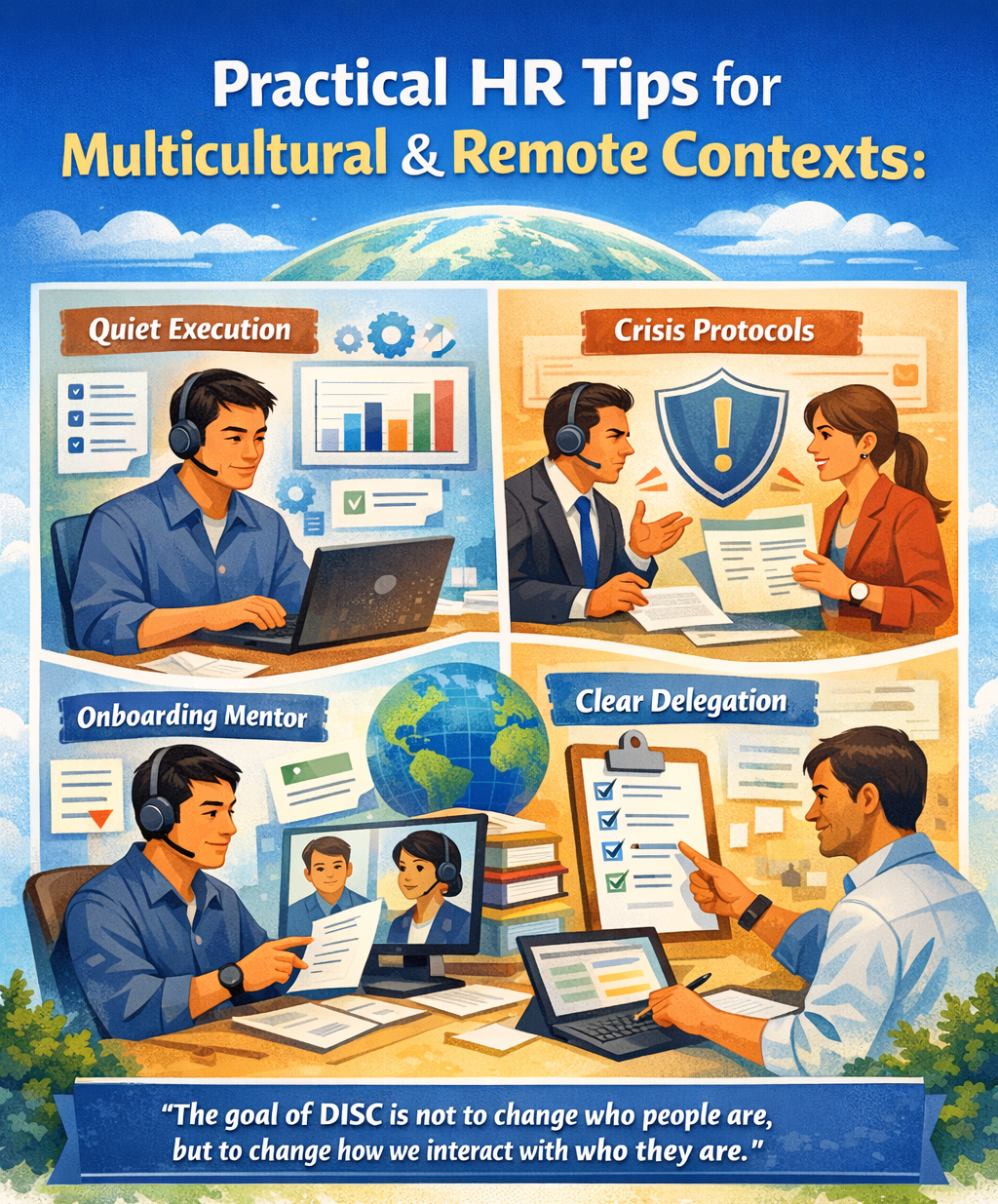
- Contextualize Quiet Execution: In cross-cultural remote environments, a High S / High C individual may not vocally self-promote. HR must establish quantitative performance tracking that captures backend, structural contributions rather than relying solely on vocal participation in meetings.
- Define Crisis Protocols: Because Zaphyr shifts to a highly rigid and defensive posture under executive pressure, establish clear, objective mediation channels. When conflicts arise, rely on written, factual exchanges rather than heated audio calls to keep his protective "Strategist" traits engaged constructively rather than destructively.
- Leverage for Onboarding: Utilize Zaphyr's "Master Craftsman" profile by assigning him as the primary mentor for new remote hires. His balance of empathy and strict adherence to protocol makes him ideal for translating complex standard operating procedures to multicultural team members.
- Avoid Ambiguity in Delegation: High C profiles require precision. HR should train management to delegate the result along with clear parameters and compliance expectations, rather than offering open-ended "figure it out" directives which will cause friction.
Section 5: Comprehensive Methodology Appendix
Process and Forensic Review
This assessment was generated through a forensic review of Zaphyr Pomicpic's complete digital footprint, spanning employment from December 2018 to July 2025. The ingestion process analyzed chat threads, email threads, video meeting transcripts, documents, attachments, and calendar notes. The text was normalized, system tokens were removed, and data was segmented into speaker-turn units retaining temporal metadata. A redaction protocol was strictly applied to external identifiers, proprietary tools, company names, and third-party personally identifiable information to ensure broad applicability and privacy while preserving Zaphyr's core subject identity.
Rationale for Dual-Variant Analysis
Traditional assessments fail to account for environmental stimuli. This methodology implements a dual-lens framework (Catalyst vs. Neutral/Positive) anchored to specific longitudinal timepoints. This ensures that the variance between Zaphyr's behavior in psychologically safe environments (building, mentoring) versus hostile environments (executive threats, lockouts) is accurately mapped, providing predictive behavioral modeling for future HR and operational deployment.
Marker-to-Dimension Mapping & Feature Extraction
Every behavioral inference is supported by verbatim markers mapped to the DISC dimensions:
| Dimension | Behavioral Markers |
|---|---|
| Dominance (D) | Imperative verbs, boundary setting, direct confrontation, ultimatums, short decisive sentences. |
| Influence (I) | Rapport-building, humor, de-escalation, persuasion, emotive exclamation, storytelling. |
| Steadiness (S) | Submission to authority, pacification, expressions of loyalty, supportive phrasing, consistent execution. |
| Compliance (C) | References to rules, labor laws, protocols, documentation requests, spreadsheets, logical step-by-step guidance. |
Scoring Rules & Normalization Formulas
- Channel Weights: To avoid overweighting a single medium, baseline weights were applied: Meetings (1.2), Calls (1.1), Emails (1.0), Chats (0.9).
- Intensity Multipliers: Repeated categorical markers within a short contextual window (e.g., clustered aggressive boundary-setting in a single messaging thread) triggered a x1.5 intensity multiplier.
- Volume Normalization: Weighted markers were divided by total markers across all dimensions to produce preliminary percentages: (Raw Count * Channel Weight * Intensity) / Total Weighted Markers = Preliminary %.
- Smoothing: A floor threshold of 5% was applied to prevent the total mathematical zeroing of minor traits during extreme catalyst events.
- Averaging Method: The career-wide assessment computed the arithmetic mean of Zaphyr's DISC percentages across the three longitudinal phases. Similarity scores were computed via cosine similarity against a canonical library of 15 composite profiles.
BEHAVIORAL ASSESSMENT ONLY - NONCLINICAL DISCLAIMER: This report is a behavioral assessment derived from digital communication patterns, metadata, and textual feature extraction. It does not constitute a medical, psychiatric, or clinical diagnosis. The inferences drawn are based strictly on the provided digital footprint and are subject to the limitations of text-based behavioral analysis. Coverage & Confidence: 100% of the provided indexed sources (chat threads, emails, meeting transcripts, and documents) were accessible and analyzed. Blocked File Impact: 0%. This complete coverage ensures high confidence across all dimension measurements.
Section 6: Machine-Readable JSON Appendix
View Full JSON Data Payload
{ "subject_id": "Zaphyr Pomicpic", "assessment_type": "Career-Wide Behavioral Evaluation (Non-Clinical)", "timestamp": "2026-04-08T00:00:00Z", "parameters": { "channel_weights": { "meetings": 1.2, "calls": 1.1, "emails": 1.0, "chats": 0.9 }, "confidence_threshold": 0.6, "intensity_multiplier": 1.5, "smoothing_floor": 0.05, "generalization_applied": true }, "career_wide_averages": [ { "variant": "Variant A (Catalyst Average)", "trigger_profile": "Organizational Volatility, Unethical Directives, System Lockouts", "averaged_normalized_scores": {"D": 25, "I": 8, "S": 25, "C": 42}, "averaged_composite_match": "Guardian of Quality / Strategist", "average_similarity_score": 0.91 }, { "variant": "Variant B (Neutral/Positive Average)", "trigger_profile": "Autonomous Mentorship, Team Capability Building, Process Engineering", "averaged_normalized_scores": {"D": 12, "I": 20, "S": 33, "C": 35}, "averaged_composite_match": "Master Craftsman", "average_similarity_score": 0.87 } ], "longitudinal_phases": [ { "period": "Phase 1: First 12 months", "variants": { "catalyst_A": { "trigger": "Abrupt personnel transitions", "normalized_scores": {"D": 15, "I": 15, "S": 40, "C": 30}, "composite_match": "Specialist / Technician", "excerpt_pointers": ["File: [Team Chat Log], Speaker: Zaphyr Pomicpic, Timestamp: Aug 03 2019, 04:01 PM - 'Yes. We are firing [Colleague F.] today?'"] }, "neutral_B": { "trigger": "Team rapport building", "normalized_scores": {"D": 10, "I": 25, "S": 35, "C": 30}, "composite_match": "Relater / Counselor", "excerpt_pointers": ["File: [Team Chat Log], Speaker: Zaphyr Pomicpic, Timestamp: Aug 15 2019, 10:05 AM - 'Calming them down as you go along the training...'"] } } }, { "period": "Phase 2: Mid-career snapshot", "variants": { "catalyst_A": { "trigger": "Executive demand for forged contracts", "normalized_scores": {"D": 15, "I": 5, "S": 25, "C": 55}, "composite_match": "Guardian of Quality", "excerpt_pointers": ["File: [Email Thread], Speaker: Zaphyr Pomicpic, Timestamp: Nov 14 2022, 9:41 AM - 'Do you need a spreadsheet for all employees, past, and present?'"] }, "neutral_B": { "trigger": "Implementation of structured training", "normalized_scores": {"D": 15, "I": 20, "S": 35, "C": 30}, "composite_match": "Master Craftsman", "excerpt_pointers": ["File: [Team Chat Log], Speaker: Zaphyr Pomicpic, Timestamp: Sep 07 2021, 03:06 PM - 'You cannot teach them everything in just a week...'"] } } }, { "period": "Phase 3: Final 12 months", "variants": { "catalyst_A": { "trigger": "System lockouts and hostile separation", "normalized_scores": {"D": 45, "I": 5, "S": 10, "C": 40}, "composite_match": "Strategist / Perfectionist", "excerpt_pointers": ["File: [Direct Messaging Log], Speaker: Zaphyr Pomicpic, Timestamp: 6/1/24, 10:08 PM - 'I am not one of your bitches.'"] }, "neutral_B": { "trigger": "Software Training development", "normalized_scores": {"D": 10, "I": 15, "S": 30, "C": 45}, "composite_match": "Master Craftsman", "excerpt_pointers": ["File: [Team Chat Log], Speaker: Zaphyr Pomicpic, Timestamp: Undated - 'This document outlines the [Financial Software]: Essential Training...'"] } } } ] }